Nomadic Foragers Tend to Have What Type of Art
Hunter-gatherer culture is a type of subsistence lifestyle that relies on hunting and fishing animals and foraging for wild vegetation and other nutrients like honey, for food. Until approximately 12,000 years ago, all humans adept hunting-gathering. Anthropologists have discovered evidence for the practice of hunter-gatherer culture past modernistic humans (Man sapiens) and their distant ancestors dating as far back every bit two meg years. Before the emergence of hunter-gatherer cultures, earlier groups relied on the do of scavenging fauna remains that predators left behind. Because hunter-gatherers did not rely on agriculture, they used mobility as a survival strategy. Indeed, the hunter-gatherer lifestyle required access to large areas of state, between seven and 500 square miles, to find the food they needed to survive. This made establishing long-term settlements impractical, and about hunter-gatherers were nomadic. Hunter-gatherer groups tended to range in size from an extended family to a larger ring of no more than than about 100 people. With the beginnings of the Neolithic Revolution about 12,000 years ago, when agricultural practices were showtime developed, some groups abased hunter-gatherer practices to establish permanent settlements that could provide for much larger populations. All the same, many hunter-gatherer behaviors persisted until modern times. As recently every bit 1500 C.E., in that location were withal hunter-gatherers in parts of Europe and throughout the Americas. Over the last 500 years, the population of hunter-gatherers has declined dramatically. Today very few exist, with the Hadza people of Tanzania being one of the concluding groups to live in this tradition.
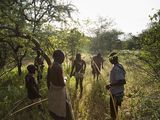
The Hadza people of Tanzania rely on hunting wild game for meat, a task that requires keen skill in tracking, teamwork, and accuracy with a bow and pointer.
Photograph past Matthieu Paley
abased
Adjective
deserted.
ancestor
Noun
organism from whom 1 is descended.
anthropologist
Substantive
person who studies cultures and characteristics of communities and civilizations.
Noun
learned behavior of people, including their languages, belief systems, social structures, institutions, and material appurtenances.
decline
Verb
to reduce or become down in number.
extended family
Noun
household in which parents, children, grandparents, and other relatives live.
forage
Verb
to search for food or other needs.
Homo sapiens
Substantive
(200,000 years ago-nowadays) species of primates (hominid) that but includes modern human beings.
hunter-gatherer
Substantive
person who gets food by using a combination of hunting, line-fishing, and foraging.
lifestyle
Noun
way of living, including cultural, economic, and social habits.
Neolithic
Noun
(~9000 B.C.E. to ~2000 B.C.E.) terminal phase of the Stone Age, following the Mesolithic.
nomadic
Describing word
having to exercise with a way of life defective permanent settlement.
Noun
substance an organism needs for energy, growth, and life.
predator
Noun
animal that hunts other animals for food.
scavenge
Verb
to feed on dead or decaying material.
settlement
Noun
community or village.
strategy
Noun
plan or method of achieving a goal.
subsistence
Noun
minimum amount of a substance that is necessary to support life, such as nutrient or shelter.
survival
Noun
ability to alive.
Substantive
behavior, community, and cultural characteristics handed down from ane generation to the next.
vegetation
Noun
all the plant life of a specific place.
Source: https://www.nationalgeographic.org/encyclopedia/hunter-gatherer-culture/
0 Response to "Nomadic Foragers Tend to Have What Type of Art"
Post a Comment