carl friedrich gauss what is the sum of 1 to 10,000
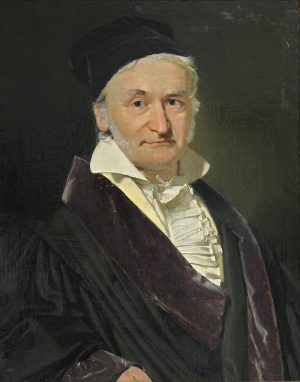
Carl Friedrich Gauss, painted by Christian Albrecht Jensen
Carl Friedrich Gauss, original name Johann Friedrich Carl Gauss, (born Apr thirty, 1777, Brunswick – died February 23, 1855, Göttingen, Hanover), German mathematician, by and large regarded as one of the greatest mathematicians of all time for his contributions to number theory, geometry, probability theory, geodesy, planetary astronomy, the theory of functions, and potential theory (including electromagnetism).
Carl Friedrich Gauss is sometimes referred to every bit the "Prince of Mathematicians" and the "greatest mathematician since antiquity". He has had a remarkable influence in many fields of mathematics and science and is ranked as one of history'south most influential mathematicians.
Gauss was a kid prodigy. There are many anecdotes concerning his precocity equally a child, and he fabricated his outset ground-breaking mathematical discoveries while still a teenager.
At just 3 years erstwhile, he corrected an error in his father payroll calculations, and he was looking later on his male parent's accounts on a regular ground by the age of 5. At the age of 7, he is reported to have amazed his teachers by summing the integers from 1 to 100 nigh instantly (having speedily spotted that the sum was really 50 pairs of numbers, with each pair summing to 101, total v,050). Past the age of 12, he was already attending gymnasium and criticizing Euclid's geometry.
Although his family was poor and working class, Gauss' intellectual abilities attracted the attending of the Duke of Brunswick, who sent him to the Collegium Carolinum at fifteen, and so to the prestigious University of Göttingen (which he attended from 1795 to 1798). It was as a teenager attending university that Gauss discovered (or independently rediscovered) several important theorems.
At fifteen, Gauss was the outset to find whatever kind of a pattern in the occurrence of prime numbers, a problem which had exercised the minds of the best mathematicians since aboriginal times. Although the occurrence of prime numbers appeared to exist almost completely random, Gauss approached the problem from a different angle by graphing the incidence of primes as the numbers increased. He noticed a rough blueprint or trend: as the numbers increased past 10, the probability of prime numbers occurring reduced by a factor of about 2 (eastward.chiliad. there is a 1 in 4 chance of getting a prime in the number from i to 100, a one in six take chances of a prime in the numbers from ane to one,000, a 1 in 8 hazard from i to 10,000, ane in 10 from 1 to 100,000, etc). However, he was quite enlightened that his method merely yielded an approximation and, as he could not definitively prove his findings, and kept them underground until much later in life.
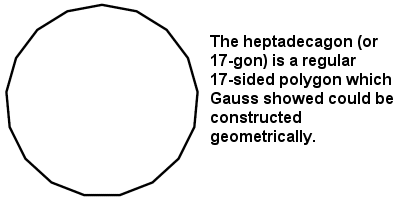
17-sided heptadecagon synthetic by Gauss
Gauss'south commencement significant discovery, in 1792, was that a regular polygon of 17 sides can be constructed by ruler and compass alone. Its significance lies not in the result only in the proof, which rested on a profound analysis of the factorization of polynomial equations and opened the door to after ideas of Galois theory. His doctoral thesis of 1797 gave a proof of the fundamental theorem of algebra: every polynomial equation with existent or complex coefficients has equally many roots (solutions) as its caste (the highest power of the variable). Gauss'due south proof, though not wholly convincing, was remarkable for its critique of earlier attempts. Gauss after gave three more than proofs of this major result, the last on the 50th ceremony of the first, which shows the importance he attached to the topic.
Gauss's recognition every bit a truly remarkable talent, though, resulted from two major publications in 1801. Foremost was his publication of the kickoff systematic textbook on algebraic number theory, Disquisitiones Arithmeticae. This book begins with the first account of modular arithmetics, gives a thorough account of the solutions of quadratic polynomials in two variables in integers, and ends with the theory of factorization mentioned above. This pick of topics and its natural generalizations set the agenda in number theory for much of the 19th century, and Gauss'due south continuing interest in the subject spurred much research, especially in German language universities.
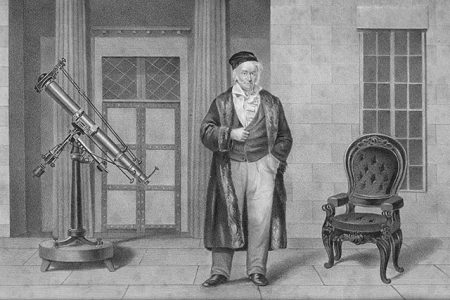
Eduard Ritmüller's portrait of Gauss on the terrace of Göttingen observatory //Carl Friedrich Gauss: Titan of Science past Thou. Waldo Dunnington, Jeremy Grey, Fritz-Egbert Dohse
The second publication was his rediscovery of the asteroid Ceres. Its original discovery, by the Italian astronomer Giuseppe Piazzi in 1800, had caused a awareness, but it vanished behind the Lord's day before enough observations could be taken to summate its orbit with sufficient accuracy to know where it would reappear. Many astronomers competed for the honor of finding it once more, merely Gauss won. His success rested on a novel method for dealing with errors in observations, today chosen the method of to the lowest degree squares. Thereafter Gauss worked for many years every bit an astronomer and published a major work on the computation of orbits—the numerical side of such work was much less onerous for him than for most people. As an intensely loyal bailiwick of the knuckles of Brunswick and, after 1807 when he returned to Göttingen as an astronomer, of the knuckles of Hanover, Gauss felt that the work was socially valuable.
In fact, Gauss ofttimes withheld publication of his discoveries. As a pupil at Göttingen, he began to doubt the a priori truth of Euclidean geometry and suspected that its truth might be empirical. For this to be the case, there must be an alternative geometric description of space. Rather than publish such a description, Gauss confined himself to criticizing various a priori defenses of Euclidean geometry. Information technology would seem that he was gradually convinced that at that place exists a logical alternative to Euclidean geometry. However, when the Hungarian János Bolyai and the Russian Nikolay Lobachevsky published their accounts of a new, non-Euclidean geometry well-nigh 1830, Gauss failed to give a coherent account of his own ideas. It is possible to draw these ideas together into an impressive whole, in which his concept of intrinsic curvature plays a central role, but Gauss never did this. Some have attributed this failure to his innate conservatism, others to his incessant inventiveness that always drew him on to the next new idea, nevertheless others to his failure to find a key idea that would govern geometry once Euclidean geometry was no longer unique. All these explanations have some merit, though none has enough to be the whole explanation.
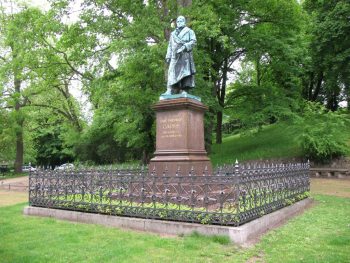
Statue of Gauss at his birthplace, Brunswick
Gauss' achievements were not limited to pure mathematics, however. During his surveying years, he invented the heliotrope, an instrument that uses a mirror to reflect sunlight over cracking distances to mark positions in a land survey. In after years, he collaborated with Wilhelm Weber on measurements of the Earth'southward magnetic field, and invented the get-go electric telegraph. In recognition of his contributions to the theory of electromagnetism, the international unit of magnetic induction is known as the gauss.
Afterwards Gauss's decease in 1855, the discovery of then many novel ideas among his unpublished papers extended his influence well into the remainder of the century.
Gauss's personal life was overshadowed by the early death of his commencement wife, Johanna Osthoff, with whom he had three children, in 1809, shortly followed by the death of one child, Louis. Gauss plunged into a depression from which he never fully recovered. He married once again, to Johanna'south all-time friend, Friderica Wilhelmine Waldeck, ordinarily known as Minna. They as well had iii children. When his second wife died in 1831 subsequently a long illness, one of his daughters, Therese, took over the household and cared for Gauss for the remainder of his life.
Source: https://germanculture.com.ua/famous-germans/carl-friedrich-gauss-the-prince-of-mathematics/
0 Response to "carl friedrich gauss what is the sum of 1 to 10,000"
Post a Comment